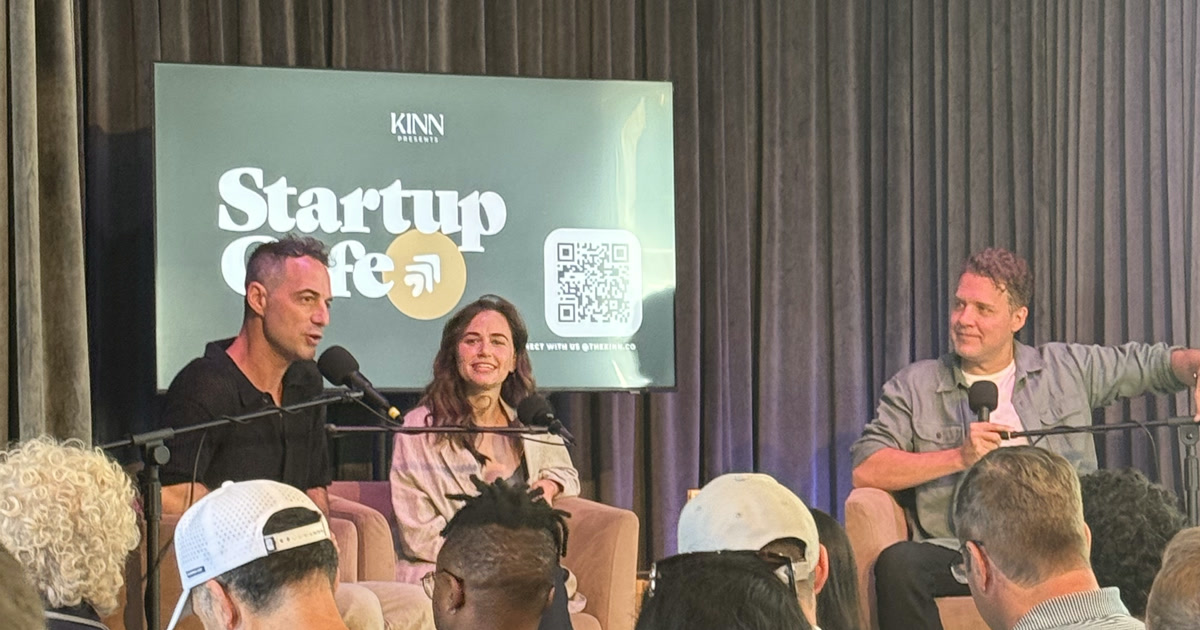
Notes from the room at Startup Cafe in Los Angeles: why brand is the moat, why AI still cannot write the sentence that matters, and the goose that lays the golden eggs.
On this page
Mark Manson has sold around 20 million copies of one book. Today I watched him tell a room full of founders in Los Angeles that the book is not his moat. Neither is the audience.
"Brand is the new moat," he said. "Distribution is downstream of brand."
I have been trying to say that sentence for three years. He said it in eight words, from a folding chair, while 500 other people online post the exact advice he gives and wonder why it never lands the same way.
That is the whole talk in one line. Here is why it wrecked me a little, and what I did with the rest of the hour.
Why this one landed
Quick context, because it is the reason I was not nodding politely.
I built and exited four agencies over twelve years. The last one had 52 full-time people and more than 600 contractors. On paper, a real company. In practice I was the bottleneck. I burned out, developed health problems, and burned a seven-year relationship to keep the thing alive. I left because I could not keep up.
Today the picture is different. My co-founder Attila and I run Markster with zero employees. Software does the repeatable work. We are more profitable than the agency ever was, and I sleep.
So when a guy who has sold 20 million books tells a room that the machinery is not the point, that the person behind it is, I am not taking notes for fun. I have paid for that lesson twice.
Manson got there the honest way. Someone asked him the standard social question, which platform, how many posts, be everywhere or go all in. He answered the mechanics, then stopped and said the part underneath. There are about 500 accounts saying the same things he says, in the same words. The words are not the moat. What is different is who he is, where he came from, what he actually believes. Strip the brand out and the content is a commodity. Keep it, and the exact same sentence is worth 20 million copies.
AI is a spike, not a wave
The other thing I have not stopped thinking about is how he talked about AI, because it is the most honest version I have heard from someone actually running the tools at scale.
His research function went from three full-time people to one. That one person now produces more than the three did two years ago. Real number, and a big one when you sit with it.
Then he drew the line. He will not let AI write a word that ships. His rule is simple: AI is fine for anything that does not need to be in the 99th percentile. The moment you need the 99th percentile, you spend more time fixing the output than you would have spent writing it yourself. Everything he publishes has to clear that bar, so the writing stays human.
He called it spiky. Insane in a few places, useless or worse in others. Same story on the software side of his second company. Some things they happily hand to Claude or Codex to build. Other things need a human engineer in the loop or it is not a fair fight. His read on the AI apocalypse: overhyped, not here, not arriving next quarter.
This is exactly what I see. We took a whole agency down to no employees using AI, and the part people miss is which parts we cut. The research, the sorting, the first eighty percent of a draft, the boring repeatable operations. Not the judgment. Not the voice. Not the sentence a client actually remembers. The last mile is still a person, and if you pretend it is not, your customers can feel it in the work.
His five-year bet is that life splits in two. Anything factual or operational, you ask a machine. Anything emotional, relational, human, you go to another person, and that side gets more valuable, not less. He wants to be on the human side. So do I.
Choose your struggle
Someone asked him to compress his entire body of work into one line. He did not hesitate.
"Choose your struggle."
Everything is hard. Relationships are hard, no relationships are hard. Building a company is brutal, not building one is its own kind of brutal. Money is hard, no money is hard. It is going to be hard either way, so pick the version of hard you actually want.
For a room of founders that is not a poster. It is a filter. He talked about learning to say no, and how the trap is that every level up hands you a new set of shiny things to turn down. Early on you decline the obvious junk. Then the book hits, and suddenly you are offered half a million dollars to fly to the other side of the world for a month, and of course you say yes, not seeing that you just gave up a month of the work that compounds. It took him a year to learn to say no to those.
He closed with something his dad told him, and I wrote it down so I would not lose it. There are two ways to win. Spend your life chasing golden eggs, or become the goose that lays them. If you are the goose, you never panic when someone walks off with one of your eggs.
That is the entire thing. Do not guard the output. Build the machine that makes it, keep it human where it counts, and let the copies go.
What I'm taking with me
Three notes, because that is all a good hour should leave you.
Brand is the moat. Distribution is what the moat produces, not the reverse. If your content could have been posted by any of the other 500 accounts in your category, you bought reach with no reason to remember you.
AI is a spike. Point it at the eighty percent that repeats and keep a person on the twenty percent that decides whether anyone cares. The founders who lose the next few years are the ones who let the machine write the sentence that was supposed to sound like them.
And choose your struggle, then be the goose. I ran the version where I was the bottleneck and it nearly ended me. The version where the systems do the work and I own the judgment is the one worth building.
Manson has sold 20 million books and just crossed 3 million dollars a year on a company that is seven months old. He is not worried about the words. He is protecting the goose. Worth stealing.
